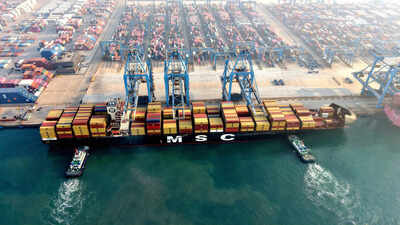
China’s economy lost pace in the April-June quarter, despite rising exports as weak domestic demand and investment dragged growth to its slowest pace in more than three years. Official data released on Wednesday showed that the economy expanded at an annualised 4.3%, down from 5% in the January-March quarter and below forecasts. Exports continued to be a bright spot for the economy with the customs data showing that outbound shipments rose 17.6% in the first half of the year compared with the same period a year ago, while exports climbed 27% in June. Growth was supported in part by the artificial intelligence boom and strong overseas demand for Chinese electric vehicles.China has also largely avoided the broader economic fallout from the Iran war, even as higher energy prices added to inflationary pressures globally.Stronger overseas demand has not yielded economic recovery at home as consumer spending and investment remained weak, reducing the overall impact of export-led manufacturing on growth.Economists have said that the economy is becoming increasingly uneven as government support and private capital continue to flow into advanced sectors such as artificial intelligence, robotics and semiconductor manufacturing, while lower-value manufacturing and service industries that generate large numbers of jobs continue to lag.The country’s push into high-tech manufacturing has driven strong growth in exports of electric vehicles, computer chips and other electronic products, backed by significant government support as advanced technology remains a key policy priority.Last year, China recorded a global trade surplus of $1.2 trillion, the highest on record. The surplus has drawn criticism from policymakers in other countries, who argue that generous state subsidies have resulted in excess manufacturing capacity, with surplus goods being exported to overseas markets.Meanwhile, the growing adoption of artificial intelligence and robotics has raised concerns within China over whether enough new jobs will be created to sustain economic growth over the longer term.Household spending has remained under pressure as families continue to hold back on major purchases amid the prolonged downturn in the property market and uncertainty over wages and employment.Mao Shengyong, deputy head of China’s National Bureau of Statistics, said that the gap between supply and demand continues to pose a challenge. “Given the increasingly unstable and uncertain global situation, the imbalance between strong supply and weak demand remains acute,” he told reporters.Mao said that as China continues to pursue “higher-quality economic growth” through high-tech manufacturing, efforts will also focus on building a stronger domestic market and supporting stable employment. Wei Li, Head of Multi-Asset Investments at BNP Paribas Securities (China), said China’s economy is undergoing a “significant transition.”Chinese leaders have set an economic growth target of between 4.5% and 5% for 2026, lower than last year’s 5%.The International Monetary Fund recently lifted its forecast for China’s economic growth this year by 0.2 percentage point to 4.6%, while projecting growth to ease further to 4.1% in 2027.